Acceleration Point Releases Study on Cushing’s Syndrome Patient Journey at ISPOR
Acceleration Point presented findings on the Cushing's Syndrome patient journey at ISPOR 2024, using social media listening to surface real-world patient perspectives where clinical data falls short.
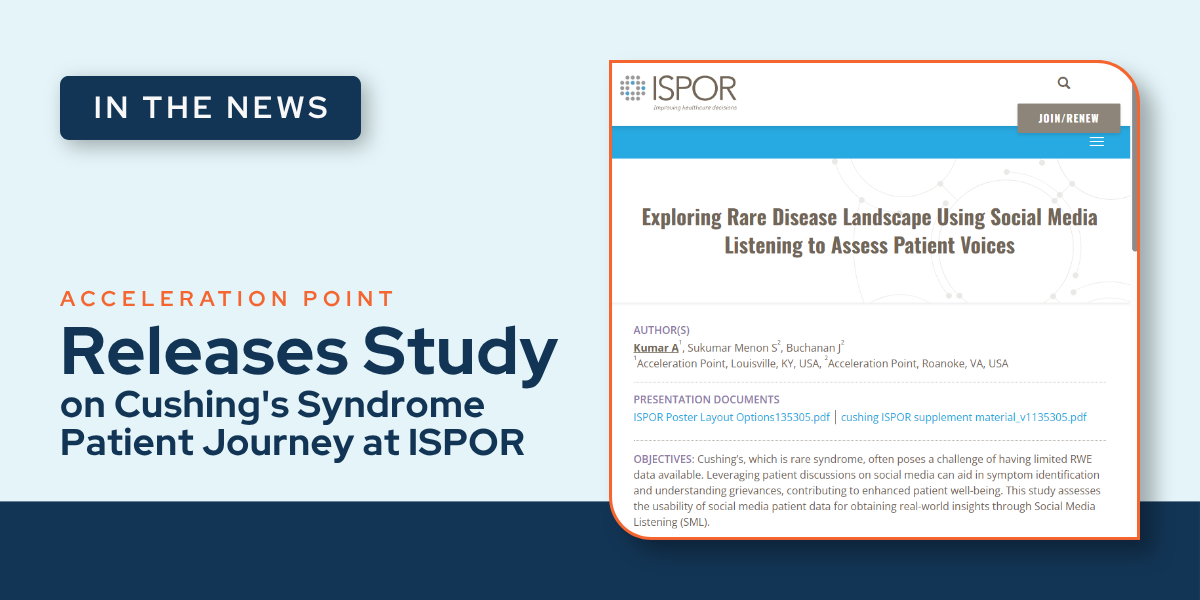
Acceleration Point presented the study Exploring Rare Disease Landscape Using Social Media Listening to Assess Patient Voices at ISPOR 2024 in Atlanta, Georgia.
The study applied patient social listening to examine the patient journey for Cushing's Syndrome (CS), with a focus on unmet patient concerns including quality of life, HCP and peer support, delayed diagnosis, missed diagnosis, and caregiver support. Cushing's Syndrome is a rare endocrine disorder caused by prolonged exposure to elevated cortisol levels, a condition for which published real-world patient data has historically been limited.
"As a company dedicated to revolutionizing insight generation for medical affairs teams, I am immensely proud of our team's unwavering commitment to empowering our customers with valuable patient insights," said Acceleration Point SVP Jeff Buchanan. "Historically, obtaining real-world, patient-focused insights has been both time-consuming and challenging, yet it remains crucial. By harnessing social media data, we enable our customers to better understand patients' challenges in diagnosis, treatment, and overall quality of life. Demonstrating this capability in diseases like Cushing's Syndrome provides access to insights where published patient data falls short."
The study found that social media listening can surface meaningful patient perspectives, particularly in rare diseases where structured data collection is difficult. Among patients who had received a Cushing's Syndrome diagnosis, 16% expressed apprehension regarding treatment and surgery, with many turning to online communities for information on navigating their condition. The study also identifies patient-focused information gaps and offers recommendations for improving patient-HCP relationships.
This work reflects a broader opportunity for Medical Affairs teams to use social media listening to better understand rare disease patients -- not as a replacement for clinical evidence, but as a complementary source of real-world context. For teams working in diseases with limited published patient data, social listening at medical congresses and beyond can help close gaps in understanding that traditional data collection cannot address.
For more information about this study, connect with our team.
Further Reading:
- Why Social Media Listening Enhances Medical Affairs' Understanding of Rare Disease Patients → https://www.accelerationpoint.com/resources/social-media-listening-enhances-medical-affairs-understanding-of-rare-disease-patients/
- Mapping the Modern Patient Journey Through Social Listening → https://www.accelerationpoint.com/resources/patient-journey-social-listening/
- Empowering Patient-Centric Medical Affairs through Patient Social Listening → https://www.accelerationpoint.com/resources/empowering-medical-affairs-through-patient-social-listening/
Explore More Resources
Discover more insights, case studies, and podcasts from our team.
Browse All Resources